Blog

  • Luscious Lunches

    Dining in France is truly delightful, as many of you probably know – and others surely suspect. In the last several days I have had two fantastic lunches, detailed below. It is not my intention to torment my readers, yet I suspect that despite this, that will be the effect for some. For this, I apologize in advance.

    While in the Loire Valley late last week, I took a break from touring the famed chateaux of the region and stopped in Vouvray for lunch. I had no specific goal in mind, had done no research on places to eat – I simply stopped at a pleasant-seeming brasserie, which turned out to be a favorite among the local workers who started streaming in a few minutes after I sat down.

    The menu du midi was as follows:

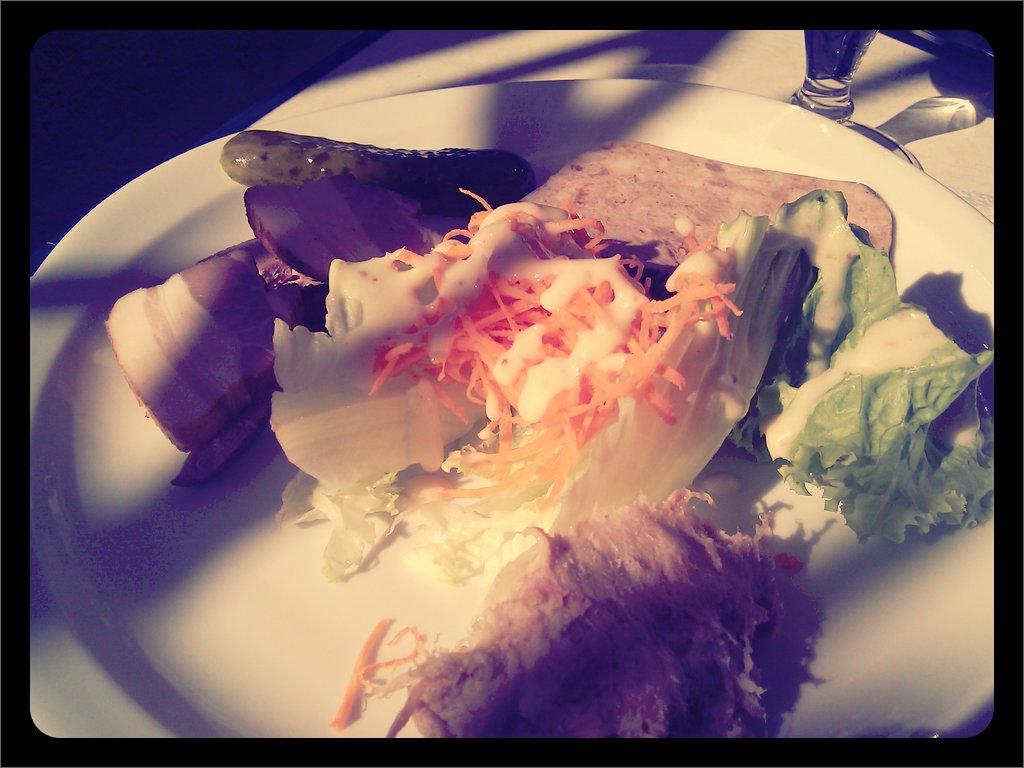
    – Assiette Charcuterie: pate, a smoked porc terrine, lardons and a delightfully crisp little gherkin, served with typically good baguette

    charcuterie

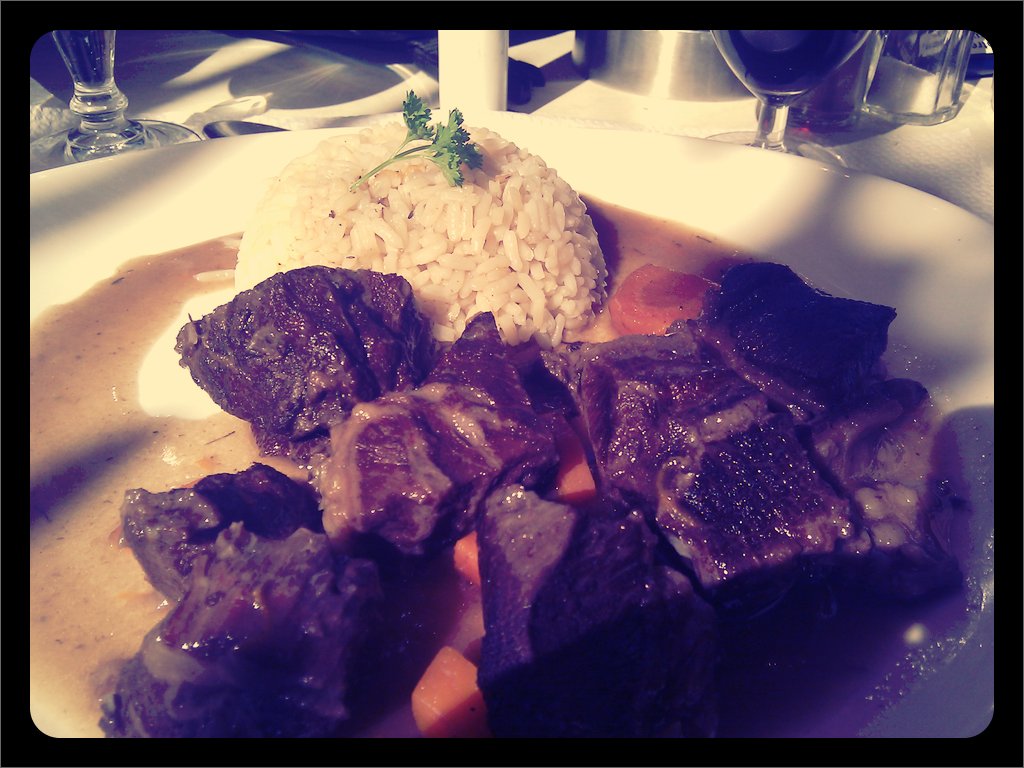
    – Boeuf Bourgoignon with rice – simple and delicious

    Boeuf Bourgoignon

    – a small cheese plate, one sheep and one goat – both with firm yet creamy interior and that wonderful almost chalky exterior common in short-aged cheeses
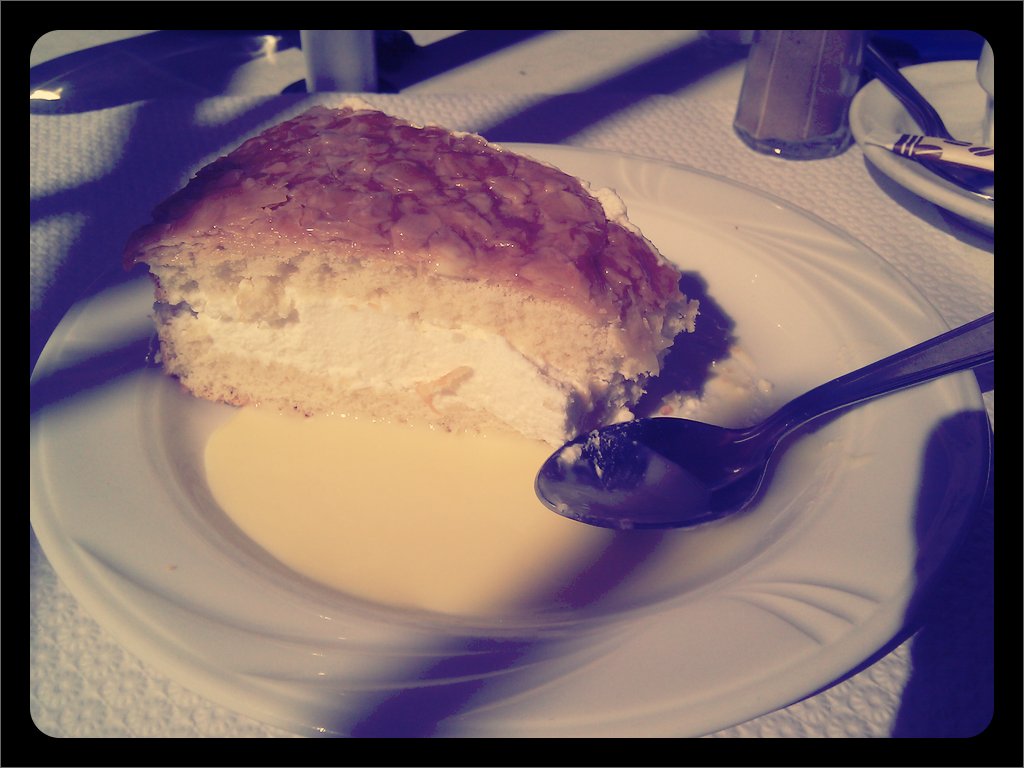
    – a delicious gateau – light cake with a rich, not too sweet cream filling and creme anglaise

    gateau

    Accompanying these were a glass of Vouvray petillant (lightly sparkling), a Chinon rouge, with a petit cafe to finish.

    This cost 16€10 in total, about $23. For four courses, two wines and coffee.

    Yesterday, while torturing myself riding through Burgundy’s Route du Grand Crus (torture because as a solo motorcyclist, I am by definition my own designated driver, so extended wine-tasting is right out, despite the wines of Burgundy being some of my favorites in the world), I stopped in the lovely medieval center of Beaune. Again, no particular goal in mind – I walked around for a few minutes perusing menus before settling in for the midday feast:

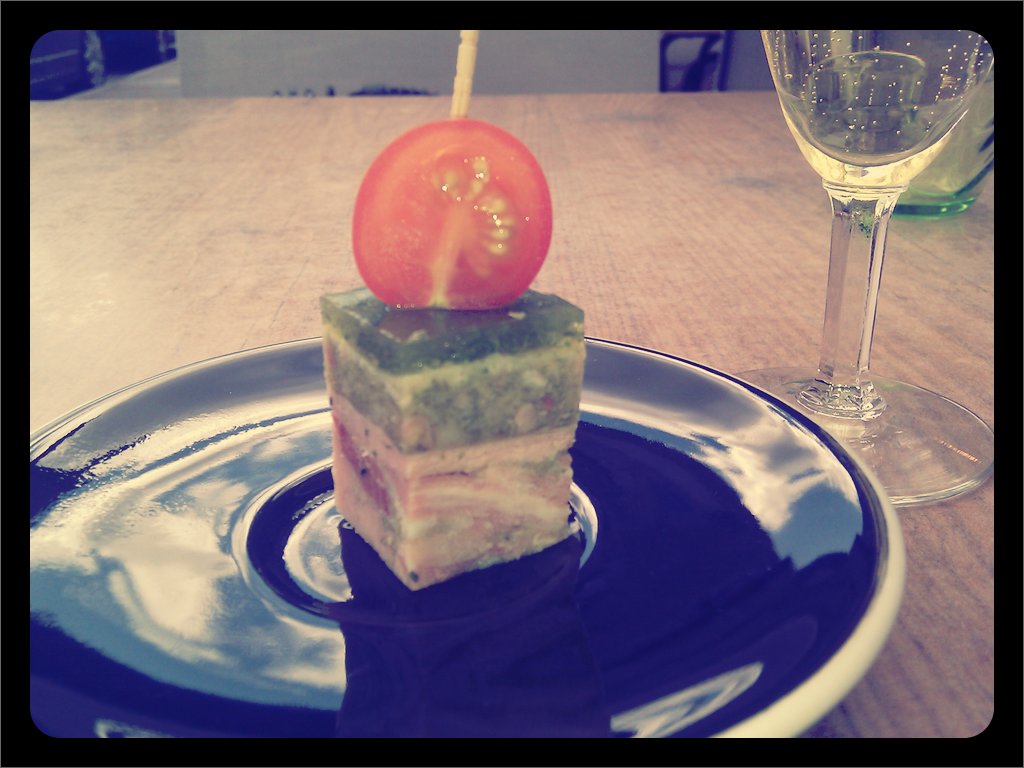
    – a complexly layered amuse bouche with jambon and poached vegetables, topped with a savory aspic

    amuse bouche

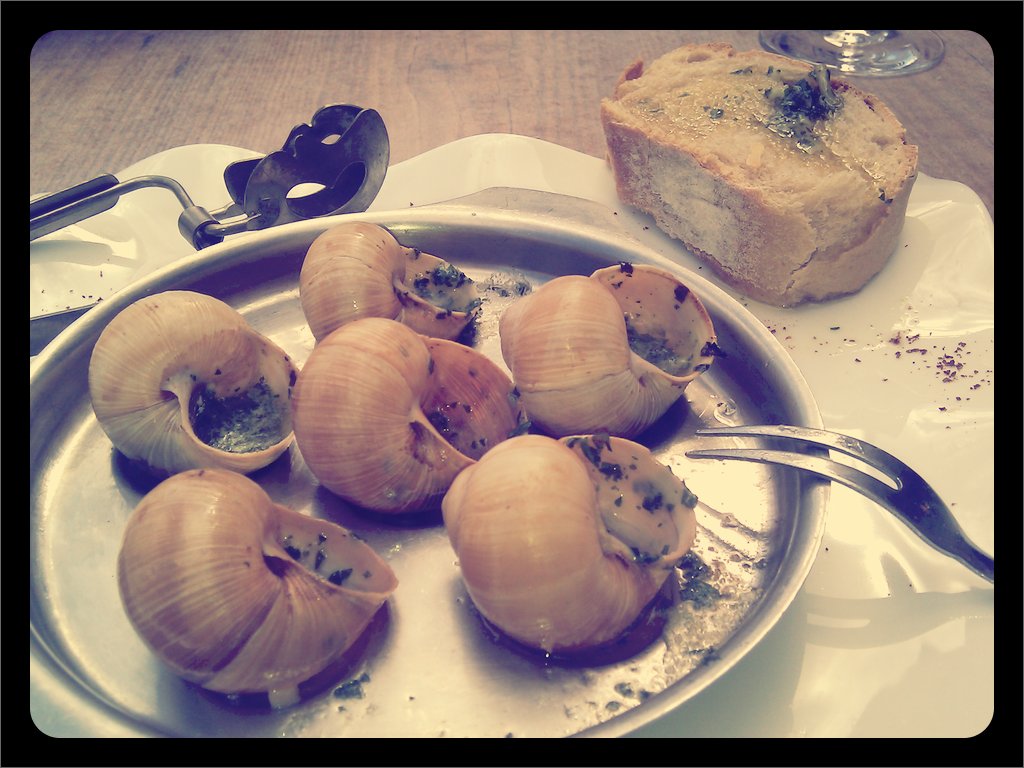
    – a half-dozen escargot, perfect in their salty-buttery-garlicky bath, served with possibly the best bread I’ve had since arriving in France – a little whole wheat flour for a bit more rustic flavor, with a crust that blurred the line between flaky and chewy in a nigh-unto-impossible fashion

    escargot

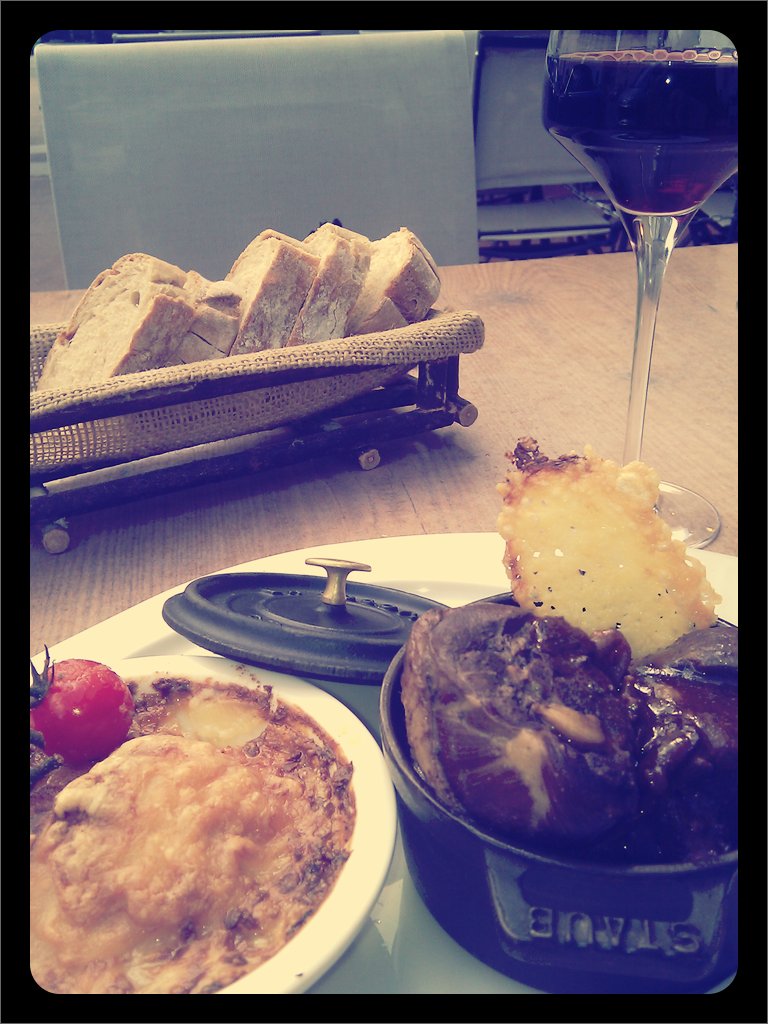
    – Coq au Vin, superb, with pommes de terre gratinee Dauphinoise (potatoes au gratin)

    Coq au Vin

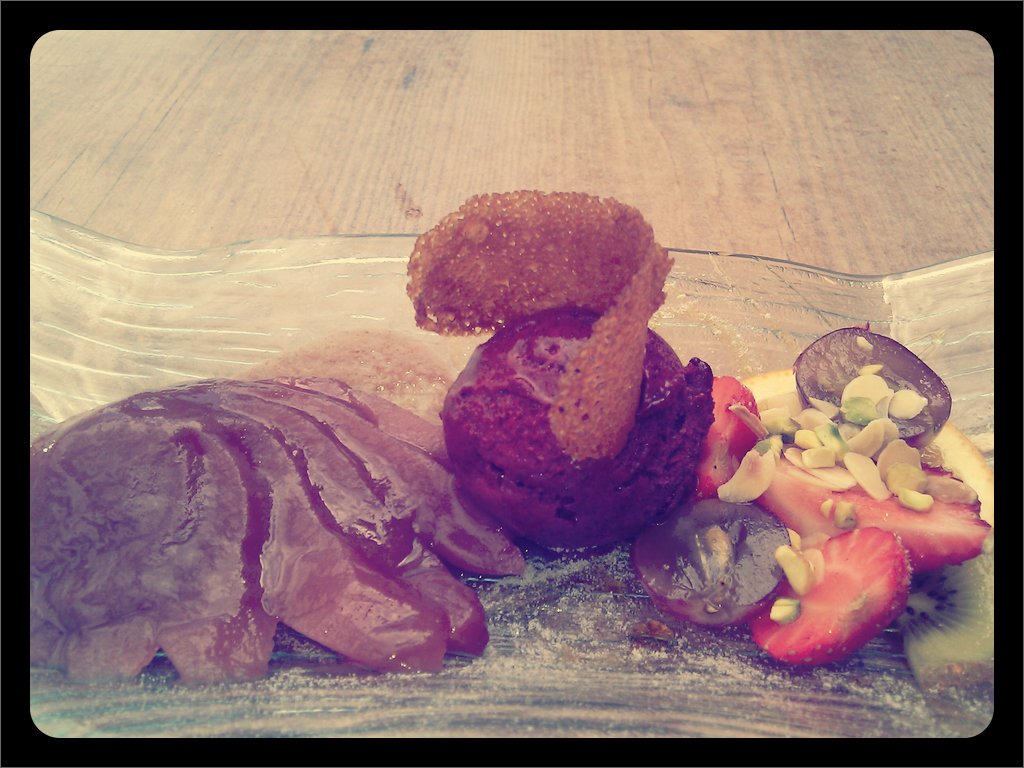
    – red wine poached pears with a sorbet that I think was cassis, and a little salad of fruits topped with chopped almonds and pistachios

    Pear poached in red wine, sorbet, fruit salad

    Accompaniments: Cremant de Bourgogne, a light but elegant Cote du Beaune rouge, and the obligatory cafe.

    This meal was more expensive, understandably, but still well worth it (particularly considering that it was my only major expense of the day other than fuel).

    In short, one could not say that I’m suffering a dearth of gustatory pleasures here in France. But then, those of you who know me well would probably bet against me suffering in that fashion, here or anywhere else.

    Addendum: additional apologies to those of you who speak French for any egregious errors in the post. Je ne parle pas bien Français.

  • Potato Chips as Cultural Indicator

    I like potato chips and other crunchy-salty-savory snacks. Back home, I don’t eat them often, but I do indeed like them. A little ways into my trip, I started noticing that each country has their own peculiar twist when in comes to flavoring potato chips.

    On this trip to date, my favorite flavors have been:

    • Ham, in Budapest (Yes, they tasted like ham. And it was good.)
    • Chevre, in Paris (Of course, this almost goes without saying.)
    • Paprika, also Budapest (Another obvious one).
    I’m sure I’ll discover other interesting and obscure flavor combinations as my travels continue. I’ll try to remember to report back if I discover any other particularly delicious local options. I look forward to Asia, source of one of my favorite crunchy-salty-savory snacks: Wasabi Shrimp chips – more like Cheetos in structure than potato chips, really, but that’s just pedantry.
  • For Inquiring Minds (France! Wine! Food!)

    Since a few people have asked what wine I’ve been drinking in France …

    When I go out to a brasserie, I usually just have whatever house rosé or rouge they have, depending on what I’m eating. Generally I don’t bother asking what it is, I just cheerfully accept it.

    When I was staying with family in Moulis-en-Médoc, we ate dinner one night at Quittignan Brillette, the bed and breakfast where we were staying. Dinner itself was fabulous: the entree was duck four ways (slices of smoked duck breast, pate & brioche toasts, poached gizzards and livers), and the plat was an excellent duck confit.

    We started with Chateau Jouvente Blanc (less than 7€), then moved to a red for the plat: Chateau Biston Brillette (around 13€, I believe). Both were quite delicious – not surprising, given that one of the proprietors of the B&B works as a wine negociant during the day, and seeks out sub-20€ wines for the house. There was a third wine, another red, but I don’t recall the name at the moment (perhaps because it was our third bottle, *after* a day touring several chateaux).

    Last night I cooked dinner (pan seared duck breasts and butter-braised radishes, turnips and carrots – both heavily influenced by recipes from Thomas Keller’s Ad Hoc At Home cookbook). With dinner, we had a lovely bottle of Chateau Gruaud Larose, followed by Sauternes from Chateau Roumieu (apologies in advance, it’s a Flash-based website, but not too terribly egregious).

    If you haven’t been able to tell from the above, I’m continuing to live well – and in order to ensure the trend continues, tonight we’re dining at Allard, a highly-reviewed Paris staple since the 1930s (though, interestingly, reviews on TripAdvisor and the like are exceptionally polarized!). And, yes, it’s two doors down from where we’re staying.

  • A Tale of Three Cities

    I’ve enjoyed a much more leisurely pace for most of August, spending a week each in Budapest, Prague and Vienna. These cities have many similarities, architecturally, culturally and otherwise, but each has its own unique feel and flair.

    This period has been my most relaxed and tourist-oriented of my trip thus far, and while it felt strange at times to not be on the road every few days, it was most enjoyable.

    FYI, this post is a little more laundry-list – and less reflective / observational – than most of my posts thus far, due to the more traditional tourist-oriented focus of these three weeks.

    Budapest was the first stop on the leisure circuit. I was joined there by Amy, my girlfriend from Seattle. This was her first time traveling abroad (I know: what?!), so early on I encouraged her to figure out what it would take for her to be comfortable. To that end, she arranged a lovely apartment on Bakats Ter, in the Pest side of the city, across from a beautiful cathedral and within walking distance of lots of the attractions of the city. We took our time getting to know the city, on the first day venturing out only far enough to acquire food and other vital concerns. Example: a representative sample of local beers, light and dark. :)

    During our stay, we struck a fine balance between relaxation and sightseeing. Some of the tourist highlights we took in were:

    • The Central Market, a vast building filled with meat and produce vendors (and cheesy tourist trinkets on the upper floor, which we visited only long enough to beat a hasty exit)
    • Buda Castle grounds, where we wandered around enjoying the views, toured a Hungarian wine museum (historical and current) and enjoyed a great tasting tour of Hungarian wines, and got to watch a young guy practicing some parkour on the castle grounds, which we both enjoyed.
    • Széchenyi Baths, one of the most famous spas in Budapest – and the only medicinal spa facility in the Pest side of the city. Historical note: the 1st century Roman settlement Aquincum, in modern northwest Budapest, was a regional capitol of the Roman Empire and was settled in large part due to the many thermal springs.
    • A visit to several of the famous “ruin bars” (Romkocsma). First we went to Lokal, a simple and low-key spot, just some tables in a gravel-covered courtyard and a limited menu of beer and cocktails. From there, we walked a few blocks to Szimpla Kert, which was fantastic. A big, sprawling space with about eight different spaces from little nooks filled with people smoking shisha to a big, crowded open-air courtyard with really varied seating options (included an old Trabant that had been modified to hold a table and seating for four). Oh, and many people who looked like they weren’t even out of high school yet.

    Given who I am, there was a quest to eat and drink some of the local specialties. These included goulash (of course), Unicum (a traditional Hungarian herbal digestif / aperitif – think Jägermeister only less cloyingly sweet, with more bitter herbs), and Pálinka (fruit brandy native to the Carpathian basin). It seems that plums are one of the most common fruits used to make Pálinka, but my favorite was an elderflower variety at Szimpla Kert. Truly amazing! I was also delighted to discover that foie gras – one of my guilty hedonistic pleasures – is a traditional Hungarian food.

    Budapest is a lovely city – split by Danube river, with hilly Buda on the west bank and mostly flat Pest to the east. I look forward to returning there one day to see more. If / when I return, I definitely plan to allot more time to the ruin bars. ;)

    Prague made up the second half of my two-week hiatus with Amy. We took a very early morning (what were we thinking?) train that got us into Prague around 1pm. We found our way to our second lovely apartment (in Praha 2 about 6 blocks south of Vinohrady and close to trams and Metro – Amy did a great job in choosing locations for our lodging!) where we proceeded to collapse from exhaustion. The next morning, I wandered a bit in order to stock up on basic foods, and discovered a very pleasant little coffee shop with quite good espresso and an offering of about a dozen whole-bean varieties. After enjoying a nice double espresso, I stocked up for the apartment and wandered home. (I like aimlessly wandering through a city quite a bit more than going to destinations.)

    We managed to see a lot of the standard tourist highlights of Prague, including:

    • The incredible grounds of Prague Castle (largest extant castle in the world), including the very impressive St. Vitus Cathedral, one of the most impressive Gothic cathedrals I’ve seen. Many of the gorgeous windows were designed and painted by Alfons Mucha, the famed Czech Art Nouveau painter.
    • Karlovy Most (Charles Bridge): Probably the most well-known of the many bridges across the Vltava river, this pedestrian-only bridge is famed for the many baroque statues lining its sides. Sadly, today it is equally known for the many vendors stationed along the way, selling photographs and paintings, jewelry, portraits and caricatures. At some point I hope to see this location at dawn, before the day’s crush of people.
    • Josefov (the historic Jewish quarter), where we visited the Pinkas Synagogue, now a museum dedicated to Holocaust victims; the Old Jewish Cemetery with its headstones crowded against each other (see my slideshow); and the Spanish Synagogue, its fantastic Moorish interior housing a museum to Jewish culture and history in Prague and the Czech Republic.
    • Historic Old Town Square and the famed Prague Orloj (Astronomical Clock), the only functional astronomical clock in the world. Amy and I found a strategic seat to enjoy a nice dinner and watch “The Walk of the Apostles”, the march of statuary figures that marks each hour (finding a seat was great – we had a great view and didn’t have to deal with the stockhouse crush of people crowded into the plaza to watch the Walk).
    • A tour group day trip to historic Sedlec and Kutna Hora. Our first stop was the renowned Sedlec Ossuary, one of the most well-known bone churches in the world. From there we proceeded to Kutna Hora, an historic silver mining center with its impressive St. Barbara’s Church and UNESCO-recognized medieval town square. This was a very enjoyable day trip, despite getting completely drenched by rain walking from St. Barbara to the city center to visit the Italian Court with its museum dedicated to the history of coin minting in Kutna Hora.
    • A visit to the Alfons Mucha Museum – as mentioned before, Mucha is well-known as a Art Nouveau painter. He spent a number of years in Paris, and is well-known block-print posters advertising theatrical productions featuring Sandra Bernhardt.
    • And, of course, we drank Absinthe (well, I did – Amy tried it and then let me finish hers). When in Prague … :)

    Prague also has a river running through its center (as do many big cities in Europe; waterways were great highways for commerce prior to trains and roadways) – in this case the Vltava (known in Germany as the Moldau). There are numerous bridges spanning the river as it winds its way through the city, offering many scenic views of both sides of the river, well worth a leisurely stroll across one or more.

    The architecture in Prague is really impressive. Compared to other European capitals, Prague was only minimally bombed (this bombing was claimed to be a mistake due to weather conditions and radar failures; the pilots and bombers believed they were part of the bombing of Dresden going on the same day). As a result, there’s a greater architectural record there, particularly of the Art Nouveau architecture style popular in the late 1800s and early 1900s. After two wonderful weeks, the time came for me and Amy to part ways – she headed home to Seattle, and I returned to Budapest on a sleeper train in order to retrieve my motorcycle and head onward.

    Vienna was my next destination, where I visited with Tünde, a lovely woman who is a cousin to Istvan, the groom in the wedding I attended in Romania. I briefly visited Vienna on my way to Romania and liked it, so when Tünde invited me to visit her there, I happily accepted.

    I don’t have as specific recollection of the places we saw, but enjoyed walking through the city with her as personal tour guide. Vienna also has numerous examples of Art Nouveau architecture (there known by the German name Jugendstil, or ‘youth style’). One highlight of the visit was the lovely Museumsquartier, a square that is home to four museums and several bars and cafes, encouraging a hearty nightlife.

    Again, a river runs through it, this time being the Donau (Danube), the second-longest river in Europe. There are fewer scenic vistas of the river in the heart of the city, though, as its main waterway runs to the east of the central area of the city.

    I ended up staying in Vienna several days longer than I originally intended, for two reasons:

    First, Tünde’s sister Emöke invited us to join her and her family for dinner – the night of the day I’d originally planned to depart. I enjoyed interacting with Emöke, her husband Tibor and their kids at the wedding, so was pleased to have a chance to spend an evening with them all.

    Then the next day as I was about to depart, I realized that my license plate was missing from my motorcycle. I don’t know whether someone decided they’d like to have a US motorcycle plate for their very own, or if it came off of its own accord somehow. No matter, really – I needed to work on getting a replacement, which required a couple days of work to get all the necessary paperwork taken care of and sent off to the US, and to get a temporary Austrian plate so that I could continue legally riding in the EU until my new plate arrived. All in all, an expensive and time-consuming process. I strongly encourage anyone traveling outside the US with your own vehicle learn from my tribulations and take extra precaution to ensure that your license plate remains attached to your vehicle.

    Tünde and I had a great time together, enjoying lots of good conversation, food and drink, exploring the city, and more. I even managed to get her to try sushi for the first time, which I consider a great accomplishment – especially given that she enjoyed it!


    I had a great time in each of these lovely cities, and encourage anyone who has considered visiting any of them but not yet acted on such considerations: do it! Eat local food, drink local refreshments, see the sights, wander around with no goal in mind and let each city deliver unto you some unexpected delights. I find that many of my best experiences in a city – any city – come from just seeing what’s around the next corner or across that bridge over there. It is possible – nay, even likely (for Americans particularly, with their limited vacation time) – to over-plan so much that one ends up harried and exhausted rather than enjoying the joy of travel at a leisurely and serendipitous pace.

    PS: I’ll be working on posting photos of these cities (and other locations visited since) soon.

  • In The Meantime …

    I am going to (try to) start interspersing shorter, more off-the-cuff posts with the big missives I’ve been writing lately. I want to update this space more frequently than I have been – partly to keep a better record of my travels for future reference, partly to reassure folks at home that all is well. ;)

    Currently I’m Bolzano, Italy after visiting with my friend Marcello for a few days. We haven’t strayed far from the city center – but that’s okay, because it’s quite lovely. The night I arrived I was swept off to two parties: The first was at the Museo d’Arte Moderna e Contemporanea (Museum of Modern and Contemporary Art) for Franz Magazine, a local (mostly-online) arts and culture magazine. The second was about 30km south of Bolzano, at the home of Italian winemaker Alois Lageder. Both were fun, filled with good-looking people and good music (and great food and wine at the latter). Yesterday was mostly mellow wandering around the city, sitting at a cafe and people-watching, casual conversation. Which was perfect after a glass or two too many of the fine vino the night before …

    Today, I’m off again, striking into the heart of the Alps. I expect to make it at least to Davos, Switzerland.

    Soon I’ll have a post about the last few weeks, spent in Budapest, Prague and Vienna. Promise!

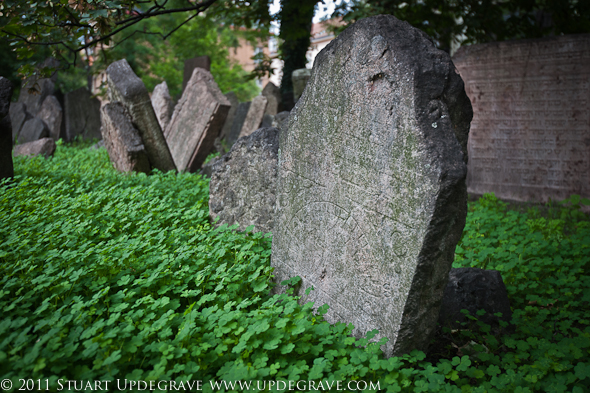
  • Old Jewish Cemetery, Prague

    Old Jewish Cemetery, Prague

    Yesterday I visited the old Jewish Quarter in Prague and toured the Jewish Museum, which spans multiple sites in the area. We toured the Pinkas Synagogue (built in the 16th century, now a Holocaust memorial) and the Spanish Synagogue (built in the 19th century, Moorish influenced interior, houses documents relating to the history of Jews in Prague as well as a large part of the local Jewish community’s collection of silver relics).

    The highlight of the tour was the Old Jewish Cemetery, the oldest extant Jewish cemetery in Europe. Jewish burial tradition forbids destroying Jewish graves or removing tombstones, so over the years that the cemetery was in use, new layers of soil were added periodically in order to allow more burials. This resulted in a massive jumble of tombstones, many leaning against each other or lined up like dominoes.

    Click on the photograph below for a small slideshow of images from the cemetery.

    And, a reminder – I love getting feedback! Please leave comments here directly, or on whichever path brought you to this page. Thanks!

  • Carpathian Countryside

    Looking down into the valley near Simeria, Romania after my attempt to detour around a traffic jam was thwarted by the path forking in four directions, none obviously heading the way I wanted.

     (Stuart Updegrave)

  • Floarea-soarelui

    Field of sunflowers outside Bulgarus, Romania.


     (Stuart Updegrave)

     (Stuart Updegrave)

  • A Week In Romania

    I recently spent most of a week in Romania, much of that time spent attending a big traditional Hungarian wedding celebration for two friends from Seattle (the groom is Romanian by birth, Hungarian by blood). While there, I experienced some lovely riding including a few epic off-road adventures, and was quite charmed by the country in a number of ways.

    I entered Romania after a long day’s ride from Vienna, in a generally southeast direction through the Pannonian Basin (also known as the Carpathian Basin) along the course of the mighty Donau river, skirting around Budapest, then on through the Great Hungarian Plain, thick with fields of corn and sunflowers, to the border. After spending so much time in the Schengen Area, it was oddly satisfying to have to stop at a border crossing and have to show not only my passport but vehicle title and registration. Happily, this was a stress-free crossing, only taking about ten minutes to get through.

    I spent my first night in the village of Bulgarus (there should be a few diacritical marks on the name, but they don’t render correctly in the post, so I’ve spelled it as closely as possible) in the northwest corner of the country, about 50km from the Hungarian border, with a CouchSurfing host named Adrian, a fellow motorcyclist. He grew up in Timisoara, 40km to the southeast, and moved to Bulgarus a year ago following a dream of a small farm. He now has a run-down house with rabbits, chickens, ducks, goats and pigs – a dog and a few small cats as well. He also has five acres where he grows wheat for the bread he bakes, cures hams and drinks the milk from his goat. He has done quite well for himself in a year.

    Adrian is also an enthusiastic CS host, having had many guests in his home over the year. The night I stayed with him, there was also a young French couple, Lucile and Gildas, also eager back-to-the-land types. The four of us sat and talked in his courtyard as night fell, sharing beer and stories of travel and simpler lives.

    The next morning, after breakfast and farm tour and morning conversation with Adrian, Lucile and Gildas, I once again hit the road – next stop: Sepsiszentgyörgy, a small city outside of Brasov in the heart of Transylvania. My route skittered up and over outlying ridges of the southern arm of the Carpathian mountains and thence along their northern terminus. As I approached the small town of Simeria, I got stuck in an horrific traffic jam. After over an hour in which I progressed barely 2km, I attempted to find a backroad detour around the mess. This resulted in about a half-hour of single-track riding, alternately delightful and nerve-wracking, on soft, moist ground (soaked from the preceding days’ rains), up into the fertile folding hills of the Carpathians. After spooking a small group of pigs – and being in turn spooked by a couple of farm dogs who realized their solemn duty to chase the intruder – I finally reached a point where the track branched in four directions, none obvious to deliver me back to the highway. After a brief stop to enjoy the scenery, I reversed course and followed my route back and into the by then dissipating traffic. This side jaunt, though not successful as a detour, gave me a chance to shake away the futility of traffic and immerse myself in the beauty of the countryside – sweet medicine indeed.

    The rest of the ride was long and tiring – the extensive delay left me with a decision to stop short of my goal or ride after dark, which I avoid doing when possible. I made the decision to push on, and finally arrived in Sepsi a little after 11pm, several hours after my expected arrival time. However, the majority of the wedding party had only arrived about 1/2 hour earlier and were eating a late dinner when I rolled into town. I joined in eagerly after a warm welcome from happy familiar faces from home, a most welcome sight!

    The next few days were a blur of tourist activities and wedding preparation, and then the wedding and reception, a 12+ hour extravaganza that included six courses spread over eight hours, several performances by a traditional Transylvanian folk dancing troupe, quite a bit of spirits – plum pálinka (Hungarian fruit brandy), cognac, a house-made blueberry liqueur, and so forth – and friendship, revelry and celebration.

    On the day after the wedding (after a healthy interval to recuperate from the previous night’s revelry), most of the guests headed up to a B&B in the mountains. I headed out on my motorcycle so that I wouldn’t be tied to the group-mind when it came time to leave. About 10km outside of Sepsi, the rain started, so I stopped to put on my rain gear. A good thing, because the next hour had me riding in and out of rain bands, which grew more vigorous as I got closer to the mountains. After a particularly lightning strike, I stopped under a tree to figure out which direction the lightning was moving, only continuing once I was comfortable it had passed away from me. The road turned to gravel once I passed the town of Covasna, and I had ~13km of highly adventurous dirt road riding in torrential rain, much of it uphill through switchbacks. In many places the easiest / safest route was through the road ruts filled with rushing muddy water – the bottoms of these ruts were likely to be gravel, a safer course than the slick muddy ridges between the ruts.

    The rain had tapered off by the time I arrived, thankfully. After drying off, I watched massive loaves of fresh bread being pulled out of the wood-fired oven, tops charred. The char was hacked off with what looked like a small hatchet, then a rap was used to clean up and shape the loaves. Delicious! Also delicious were the many little glasses of plum and homemade blueberry pálinka, cognac and later Unicum. There was a big bonfire on the hillside, good conversation with friends old and new, and another too-late night.

    I stayed in the mountains for another night after the bulk of the wedding guests had left, wanting a little quiet time to enjoy the peace of the hills and trees and river, and to enjoy more relaxed company and conversation with new friends – two of the grooms cousins and one’s husband.

    And then, back towards Hungary, with a night’s stop in Timisoara. I retraced my route (sadly; had I more time, I would have loved to ride either the Transfagarasan or Transalpina, two highways which strike across the heart of the southern Carpathians. These are supposed to both be excellent motorcycle roads. Ah, well, that just means I now have an excuse to return, right?

    Timisoara is another lovely old city – a little historical trivia: it was the first city in mainland Europe to have electric street lamps – and I enjoyed a few brief tours with my CS host there, Silvana. She teaches languages, but her real joy is music. We talked for a couple of hours about bands, best concerts we’ve seen, and so on.

    Before I draw this post to a close, a few general observations:

    Romania is a disheveled beauty of a country, a captivating blend of modernity and old ways. I saw many horse-drawn carriages bearing people and crops, sharing the roadways with BMWs and Mercedes and long-haul semis. There are many small villages where people stand by the roadside vending produce from their farms, split firewood for the winter’s warmth or just sit on a bench talking with family or friends and watching the traffic flow by.

    There doesn’t seem to be an overwhelming tourist industry yet, except for a few obvious places – Bran Castle (the aforementioned one-time home of ‘Count Dracula’) has a thriving tourist business, Brasov and Timisoara have central pedestrian plazas lined with upscale shops, pubs and cafes and gelato stands. Yet these stand in sharp contrast to the decaying buildings, layers of plaster eroding away to expose the brick and stone underneath. On one level, the buildings remind me of Thailand – more focus on making livable spaces rather than perfect exteriors. Cities are filled with fashionable, well-dressed young women and men, while the countryside and small towns seem to be mostly children, parents and the older generations – most of the young adults seem to be those well-dressed people in the cities. Seeing shepherds tending their flocks, farmers in fields with horse-drawn plows – Romania is a study in contrasts.

    I hope to return and see more of this country.


  • Five Days of Beauty (and Rain)

    Over the course of last weekend and early this week, I spent five days riding from Barcelona to Munich. My route crossed many beautiful places, from the coastal Pyrenees, through the wine regions of Languedoc-Rousillon and Provence, up and over the Alps from France to Italy, thence to the low agricultural plains of northwestern Italy, and once more across the Alps – this time through the long fjord-like lakes of Italy and over the solid rocky heart through Switzerland and Austria before finally dropping down again for the final stretch to Munich.

    It was tough to leave Barcelona – I spent four days there after my dusty fabulous week at Nowhere, and really fell in love with the place. It’s beautiful and warm, filled with delicious food and a lovely, genial population. It helped, of course, that I had great new friends to stay with right in the center of the city. I liked it so much there that I’m planning to spend the month of November there, to take Spanish lessons (I know, it’s a Catalonian city – one friend likened this to going to Quebec to study English), spend more time with my new friends there and have a comfortable jumping-off spot for day and overnight trips around Spain.

    Once I was on the road, however, it was pretty riding. Despite sticking to the motorway for the day’s travel, the trip across the Pyrenees – close to the Mediterranean coast – was very scenic. Once through the mountains and into France, I rode along the coast – and through numerous vineyard areas – for a while before heading north again to Montpellier, my destination for the night.

    Once in Montpellier, I met up with Helene, my Couchsurfing host for the night. After I’d had a chance to clean up a bit, we went into the city center for an impromptu tour of historical and architectural locales, then to the central plaza for the weekly Friday night fest – food, wine and tchotchke vendors, live music and more. Helene is a tango dancer, and I was delighted to get a chance to watch her dance with several partners – I’d never watched tango in person before, and found it to be visually very sensual and appealing. Watching it also made me realize how much I’ve missed my days of swing dancing, one of the many activities that have fallen by the wayside as my ankle has gotten worse over the years (for those who don’t know, I have arthritis in my right ankle as a result of several bad sprains many years ago).

    The next morning, we each headed on our way – Helene to visit her mother, and I to cross the Alps into France, with the goal of reaching Lugano, Switzerland. Well, that wasn’t to be until the next day – I was so taken by the beauty of the Alpes-de-Haute-Provence region that I lingered. I dawdled. I (figuratively) dragged my feet, soaking in the loveliness. And then, late in the day, I entered Les Gorges du Verdon, and was undone. The Verdon Gorge – sometimes referred to as the Grand Canyon of Europe – is a stunning, deep river canyon (up to 700m at its deepest) through sheer limestone walls. I was there just too late to see the evening sun coloring the walls, but couldn’t help but imagine them painted in the reds and pinks and oranges which danced across the stone faces just before the entrance to the gorge itself.

    Once through the most spectacular portion of the gorge, I pulled into a campsite just outside of La Palud-sur-Verdon. It was there the next morning where I realized that, in addition to tourists with an interest in natural beauty, the Verdon Gorge was a magnet for rock climbers. The unmistakeable clink of carabiners and other climbing protection tinkled quietly from several campsites around me, as climbers from all over Europe prepared for the day’s adventures. For me, it was back into the saddle and up and over the Alps, from France into Italy. That day was probably the single most technical day of riding I’ve ever experienced. For the riders and road geeks out there, check out this map of my route: La Palud-sur-Verdon to Barcelonette to Cuneo. Zoom in on the section between Colmars and Barcelonnette, and again in Italy, on the stretch from just west of Argentera to about Pontebernardo. I didn’t manage to ride the Dragon’s Tail in the Smokies on my way across the US, but I think this day made up for it. Of course, it would’ve been nicer without the torrential rain on the climb out of Barcelonnette to around Meyronnes. Yes, that would’ve been much nicer.

    As I mentioned before, my goal for the day was to reach Lugano, CH – but crossing two passes in the Alps, one in heavy rain, had wrung me out completely by the time I reached reasonably flat terrain again near Cuneo. I pushed on for a while until I realized the utter depth of my exhaustion, and stopped for the night in Fossano, where I dried out, got some food and a beer, and collapsed like a lump into my bed.

    The next day, I struck out for Lugano. Another beautiful day’s riding, this time through rolling hills and down onto the flat plains of northwestern Italy. My route took me past vineyards, huge fields of corn and the deep emerald lushness of many rice paddies. I rode through and by towns with familiar names – Alba, Asti – gently cursing the fact that delicious wines and motorcycling don’t mix, and then entered the stunning Lakes District as I approached Lugano, and with it more rain.

    Sadly, I failed to connect with a friend working the summer in Lugano, as his work schedule and my reticence to don my sodden riding gear conspired to keep us apart. So I found myself a bed in the local hostel, a decent meal and a few beers, and then delicious slumber.

    My final day’s ride of this particular sprint took me deep into and across the heart of the Alps – along the coastline of Lago di Lugano and Lago di Como, then up and up into deep valleys lined with sharp serrated cliffs of stone. Through Switzerland into Italy, then back into Switzerland again for several beautiful passes before descending through the Tyrolean Alps of Austria – to my eyes the most beautiful region of the Alps I’ve seen to date.

    Finally, after threading my way through the northern valleys, into Germany and hurtling on the A9 to Munich, where I was warmly greeted by my friends Mellington and Oliver. I spent several fun days in Munich visiting with them – and with Margherita and Andrea, new friends met at Nowhere – but that telling can wait for another day.